


Archaeological human remains will be shown in images below.
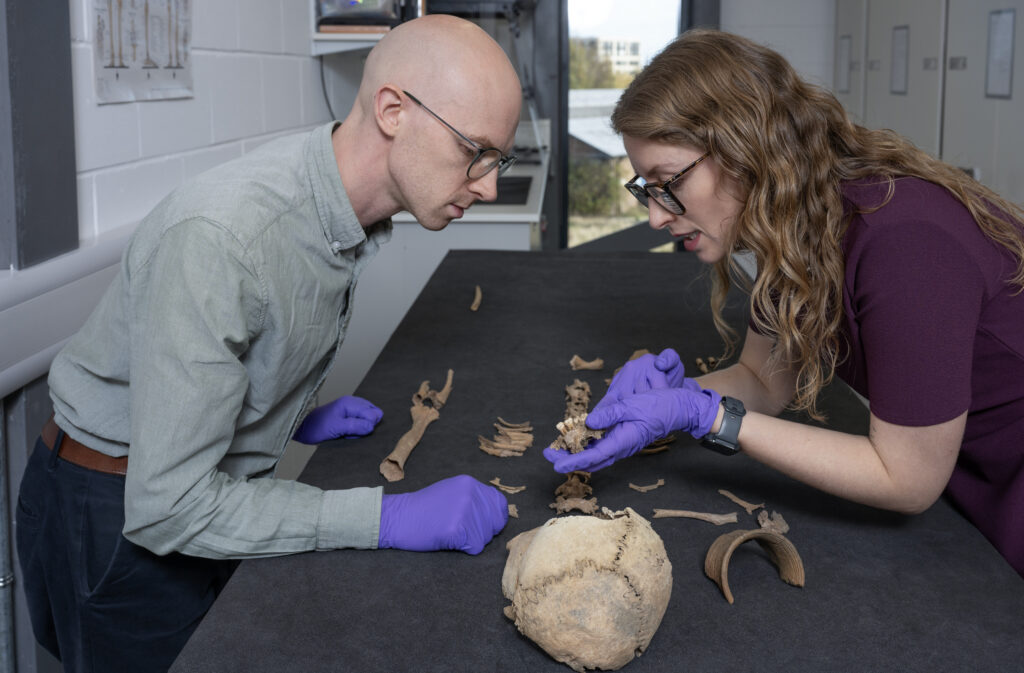
The Scotland’s Archaeological Human Remains Collection (SAHRC) RICHeS-funded investment at the National Museums Collection Centre (NMCC), Edinburgh is open for access. This enhanced collection and research facility is dedicated to the care and curation of archaeological human remains from Scotland. SAHRC is a collaborative project, led by National Museums Scotland and Historic Environment Scotland, designed to ensure the implementation of best practices in ethical care for human remains.
The facility is overseen by the first dedicated Curator of Osteoarchaeology in Scotland, supported by RICHeS, who will realise the potential of the human remains collection and disseminate knowledge and guidance to the sector. Since becoming operational in September 2025, the facility has already had demonstrable benefit not only for the National Museums Scotland collection, but also collections across Scotland.
Re-storing collections
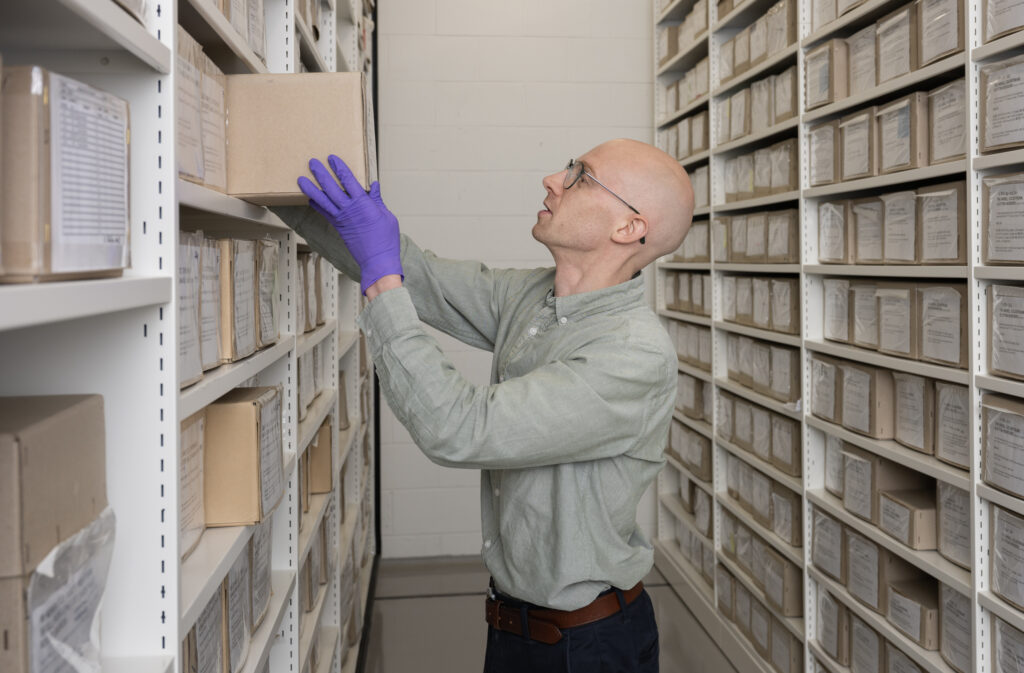
A key aspect of the RICHeS investment was expanding and enhancing the existing archaeological human remains facility and research equipment at the NMCC. Over 70% more storage space was built, and the facility now features equipment including structured light scanners and a fume hood, available for use by both staff and visiting researchers. This allows human remains to be studied and sampled (for analyses such as radiocarbon dating) on site.
Since completion of the building work, the human remains are being systematically re-boxed in line with best conservation practices. RICHeS investment has enabled the purchase of custom acid-free storage boxes for the human remains to safeguard the collection, and over 250 boxes have now been repacked. Accessibility of the collection is also key, both physically and digitally, with several hundred new searchable records created for human remains as their registration is improved.
The enhanced facility has created new opportunities to bring archaeological human remains collections into museum stewardship across Scotland, rather than being stored with excavators with no route to museum collections. Working with Historic Envrionment Scotland, it has been possible to transfer human remains from more than 40 sites either to National Museums Scotland or to other museums in Scotland. As a result, these collections are now being cared for in appropriate museum environments, improving their long-term preservation while making them more accessible for research, learning and future public engagement to better understand Scotland’s past.
Sector collaboration and outreach
Collaboration and outreach have been critical to SAHRC, with the project team producing informative outputs as well as regularly visiting excavation sites and museum collections across Scotland to better understand the issues facing the sector. These trips have provided unprecedented opportunities to share knowledge.
In November 2025, National Museums Scotland and Historic Environment Scotland hosted nine curators and collections staff from Scottish museums to discuss their experiences around the curation and display of human remains and teach practical skills such as packing. Feedback was overwhelmingly positive, achieving the aim of improving confidence in curation across the sector, with similar events planned for the future. As a result of this sector engagement, in May 2026, Curator of Osteoarchaeology Dr Jess Thompson worked with Curator of Collections at Shetland Museum and Gallery Jenny Murray, to improve the storage and description of their archaeological human remains collection. This work will ensure long-term ethical curation of this important collection.
Dr Thompson now also hosts a team of volunteers to work with the human remains collection, providing career development opportunities. Through dedicated leadership and sector-wide guidance, this investment is building capability by supporting individuals and museums across Scotland to more confidently manage and responsibly care for human remains.
Unlocking research potential
The research potential of the collection has long been recognised. With new equipment and a dedicated RICHeS-funded Curator this can now be realised, and best ethical practices for the analysis and sampling of human remains can be implemented. RICHeS-funded structured light scanners allow the creation of 3D digital models of human remains that capture critical information for research purposes and ahead of any destructive sampling. A dedicated radiocarbon dating programme of undated individuals in the collections is also enhancing knowledge and will be made available for future researchers.
Researchers interested in accessing the collection can contact: Dr Jess Thompson (j.thompson@nms.ac.uk).
For information on services available, visit the HSDS Catalogue of Services.
You can keep up to date with this investment on the National Museums Scotland website.