







“Sharing the launch of the HSDS Catalogue of Services with the heritage science community is a major milestone. Since the launch we have already added new features to aid user navigation and support Service Providers. I look forward to further expanding its reach and introducing additional new features that empower the sector to fully unlock its potential.”
Jo Tozer, HSDS Service Manager
Context and challenge
Heritage science and conservation research plays a vital role in advancing knowledge of and caring for the UK’s historic buildings, collections, landscapes and cultural heritage. This work depends on collaborations and access to a diverse range of dispersed specialist facilities, collections and expertise.
Historically, there has been no single, easy way for researchers to identify what services are available, where they can be found, and how they can be accessed. RICHeS baseline evidence highlights the scale of this challenge, with more than half of community members surveyed reporting difficulties finding out what heritage science infrastructure was available to them. The new Heritage Science Data Service (HSDS) Catalogue of Services was developed to respond to the challenges of findability and usability and to support more efficient use of infrastructure and effective collaborative research across the UK.
Investment in action
The Catalogue of Services is a key component of the suite of digital research services delivered by the Heritage Science Data Service (HSDS) for RICHeS. Prior to its launch on 1 October 2025, the HSDS team worked with partners at Manchester Metropolitan University and across the consortium to develop the platform and compile service information. One year on, the Catalogue features 60 services, bringing together advanced analytical facilities and nationally significant reference collections in a single searchable resource.
Through this investment, RICHeS is making it easier for researchers across the UK to discover and access the expertise and infrastructure needed to pursue ambitious research. The Catalogue is already demonstrating growing engagement, attracting nearly 17,000 unique page views in its first operational year. With 74% of visits in August 2026 coming from first-time users, the resource is reaching new audiences and increasing awareness of the facilities, collections and expertise available.
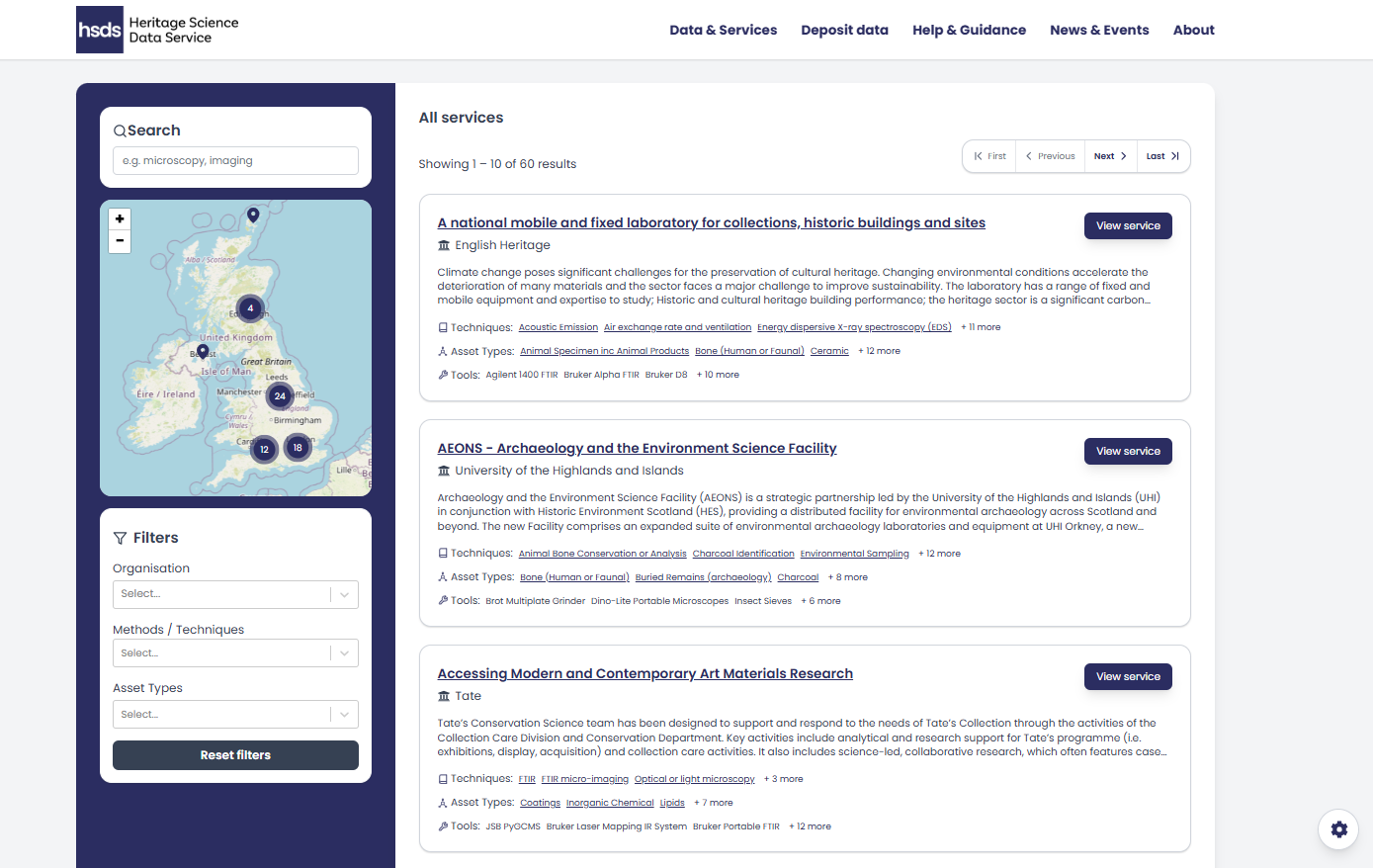
Throughout its first operational year, the Catalogue’s iterative development has continued to be shaped by direct engagement with the heritage science community, through User Needs Surveys delivered by the National Heritage Science Forum and at multiple events. Feedback from user needs surveys highlighted the importance of practical information, and in response, the Catalogue has been enhanced with free-text and map-based searching, improved filtering and clearer links to Service Providers. Together these make it easier for researchers to identify relevant infrastructure and take the next steps.
Filters are also in place to enable navigation. In addition to searching by location or organisation, users can filter by asset types, such as bone or pigment, to explore what services, and accompanying expertise, may be suitable. In cases where the methodologies desired are already known, a methods or techniques filter is also available to support efficient identification of available research infrastructure.
Unlocking collaborations
Connecting people is at the heart of creating new collaborations. To support this, contact details are provided for each Service Provider on the Catalogue that users are encouraged to utilise to explore ideas. One collaboration that emerged through the Catalogue of Services brought together researchers from the University of the Arts London (UAL) and Historic Royal Palaces to investigate the Ballets Russes Collection held by the UAL Archives and Special Collections Centre.
Reflecting on the experience, Rhosyn Tuta and Jacqueline Winston-Silk, from UAL said:
“The HSDS Catalogue of Services allowed us to quickly and easily establish an invaluable partnership with Historic Royal Palaces based not only on highly specialist equipment and expertise, but also a shared affinity for historic costume collections. We wholeheartedly recommend the Catalogue for anyone wishing to learn more about their collections and/or open new pathways to interdisciplinary research.”
This collaboration highlights the Catalogue’s role as a gateway to accessing expertise and infrastructure. Its true benefit comes from the variety of opportunities it enables, connecting users such as academic researchers, museum professionals and independent practitioners with the expertise, facilities and collections they need to undertake innovative and impactful research.
Shaping the future of the Catalogue
The Catalogue continues to evolve, and plans already include developing illustrative case studies to further support users to identify potential Services to meet their research needs. Development will continue to be informed by a further User Needs Survey in 2027. Details on how to get involved will be available through the HSDS News and Events, alongside training opportunities.
As the Catalogue develops, it will continue to strengthen the findability and usability of the UK’s heritage science and conservation infrastructure. By helping researchers, heritage organisations and independent practitioners find the facilities, collections and expertise they need, RICHeS investment in the HSDS is creating a lasting digital resource that supports collaborations, enables more efficient use of infrastructure, and helps build a more connected and sustainable heritage science community.